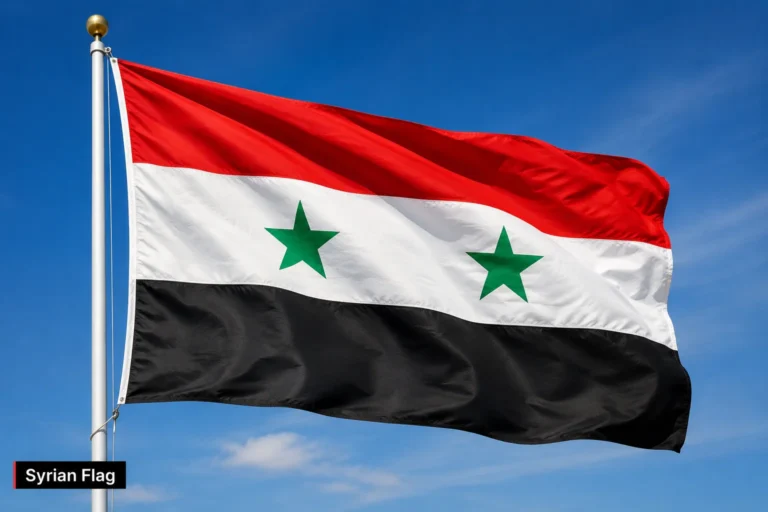
The Syrian flag is far more than a piece of colored fabric. It represents a nation’s history, struggles, independence movements, political transformations, and aspirations for the future. Throughout the twentieth and twenty-first centuries, Syria has experienced numerous political changes, and its national flag has evolved alongside those events.
Today, the Syrian flag consists of three horizontal stripes—green, white, and black—with three red five-pointed stars centered in the white band. This design is often called the Independence Flag because it originated during Syria’s struggle for independence from French rule in the 1930s and later became a symbol of national sovereignty. Following political changes in late 2024 and constitutional reforms in 2025, this historic design was officially restored as Syria’s national flag.
The flag carries deep historical and cultural meaning. Every color and star tells part of Syria’s story, connecting modern Syria to centuries of Arab and Islamic history. Understanding the Syrian flag helps explain not only the country’s past but also its identity in the present day.
What Is the Current Syrian Flag?
Design of the Modern Syrian Flag
The current Syrian flag features three equal horizontal stripes:
- Green stripe on top
- White stripe in the center
- Black stripe at the bottom
- Three red five-pointed stars centered in the white stripe
The flag uses a 2:3 ratio and was formally recognized under Syria’s constitutional framework in 2025.
Its appearance is simple yet highly symbolic. The design reflects Syria’s connection to the broader Arab world while also highlighting its unique national history.
Why Is It Called the Independence Flag?
The current design is commonly known as the Independence Flag because it was originally adopted during the period when Syria was moving toward independence from French control.
The flag first emerged in the early 1930s and later became associated with the independent Syrian Republic. For many Syrians, it symbolizes freedom, self-determination, and national unity.
Its restoration in 2025 was viewed by supporters as a return to one of the country’s most important historical symbols.
A Flag Recognized Worldwide
Today, the Syrian flag flies above government institutions, embassies, international organizations, and public buildings.
The flag is also widely used by Syrians living abroad as a symbol of national identity and cultural heritage.
As international recognition of the updated flag increased, major organizations and technology companies gradually updated their representations of Syria’s national symbol.
Meaning of the Syrian Flag Colors
Green Stripe
The green stripe is traditionally associated with the Rashidun Caliphate, the first major Islamic caliphate following the death of Prophet Muhammad.
Green has long been connected with Islamic civilization and holds special significance throughout much of the Arab and Muslim world.
Within the Syrian flag, the green stripe symbolizes both historical heritage and renewal.
White Stripe
The white stripe represents the Umayyad Caliphate, one of the most influential Islamic empires in history.
This connection is particularly meaningful for Syria because Damascus served as the capital of the Umayyad Empire during its golden age.
White is often interpreted as a symbol of peace, hope, and a brighter future.
Black Stripe
The black stripe symbolizes the Abbasid Caliphate, another major chapter in Arab and Islamic history.
The Abbasids played a crucial role in advancing science, culture, literature, and scholarship across the Middle East and beyond.
The inclusion of black acknowledges this historical legacy while reinforcing Syria’s place within the broader Arab world.
What Do the Three Red Stars Mean?
Historical Interpretation
One of the most distinctive elements of the Syrian flag is the presence of three red stars.
Historically, these stars represented the regions that formed the Syrian Republic during the independence era:
- Damascus
- Aleppo
- Deir ez-Zor
These regions played central roles in the formation of modern Syria.
Symbol of Unity
Beyond geography, the stars symbolize national unity.
The three stars remind citizens that Syria’s strength comes from bringing together diverse regions, cultures, and communities under one national identity.
This symbolism has remained powerful throughout the country’s modern history.
Modern Interpretations
Many Syrians today also associate the three stars with broader values such as:
- Freedom
- Dignity
- Justice
- Independence
- National pride
While interpretations vary, the stars continue to serve as a powerful symbol of unity and hope.
Origins of the Syrian Flag
Influence of the Arab Revolt
The roots of the Syrian flag can be traced back to the Arab Revolt during World War I.
In 1917, the Arab Revolt Flag was introduced as a symbol of Arab independence and unity.
Its colors—black, green, white, and red—later became known as the Pan-Arab colors and influenced numerous Arab national flags.
Early Syrian Independence Movements
When Arab nationalists sought independence from foreign rule, these colors became associated with self-determination and sovereignty.
Early Syrian leaders adopted designs inspired by the Arab Revolt Flag while creating symbols unique to Syria’s national identity.
Development of a National Symbol
During the French Mandate period, Syrian nationalists worked toward establishing a unified independent state.
The green-white-black tricolor with red stars eventually emerged as a powerful expression of those aspirations.
Syrian Flag During the French Mandate
Political Background
After World War I, Syria came under French administration through the League of Nations Mandate system.
Many Syrians opposed foreign control and sought independence.
National symbols became important tools in expressing political aspirations.
Adoption of the Independence Flag
In 1932, a version of the green-white-black flag featuring three red stars was officially adopted.
The design quickly became associated with the growing independence movement.
Growing National Significance
As calls for independence increased, the flag evolved into a symbol of resistance and national unity.
It remained closely tied to Syria’s struggle for self-rule throughout the remaining years of French administration.
The Flag After Independence
Independence in 1946
Following the end of the French Mandate, Syria achieved full independence in 1946.
The independence-era flag continued to represent the new Syrian Republic.
For many citizens, the flag embodied decades of political struggle and sacrifice.
Nation-Building Years
The years after independence were marked by efforts to establish stable political institutions and define Syria’s role in the Arab world.
The national flag became a central symbol during this period of transformation.
Representation on the International Stage
As Syria joined international organizations and expanded diplomatic relations, the flag served as the country’s visual identity abroad.
Its colors and stars became recognized symbols of Syrian sovereignty.
The United Arab Republic Era
Union With Egypt
In 1958, Syria and Egypt formed the United Arab Republic (UAR), a political union intended to promote Arab unity.
A new flag was adopted featuring:
- Red top stripe
- White center stripe
- Black bottom stripe
- Two green stars
The stars represented Syria and Egypt as the two constituent states.
Symbolism of the Two-Star Flag
The UAR flag emphasized Pan-Arab ideals and regional cooperation.
Although the political union lasted only a few years, the flag became one of the most recognizable symbols in modern Syrian history.
End of the Union
The United Arab Republic dissolved in 1961.
Despite the union’s collapse, variations of the red-white-black design continued to influence Syrian flags for decades afterward.
Syrian Flags Between 1961 and 2024
Multiple Political Changes
From the 1960s onward, Syria experienced coups, political transitions, and constitutional changes.
These developments were often reflected in modifications to national symbols.
Ba’ath Era Flag
In 1980, Syria officially adopted a version of the former United Arab Republic flag featuring:
- Red stripe
- White stripe
- Black stripe
- Two green stars
This remained the country’s internationally recognized flag until late 2024.
Decades of Recognition
For more than forty years, this two-star flag represented Syria at:
- United Nations meetings
- International sporting events
- Diplomatic missions
- Government institutions
As a result, many people around the world became familiar with this design.
Return of the Three-Star Flag
Political Changes in 2024
In December 2024, major political changes occurred in Syria.
As new authorities emerged, the historic three-star independence flag became increasingly visible across the country.
Constitutional Recognition
In March 2025, Syria’s constitutional declaration formally recognized the green-white-black flag with three red stars as the country’s national flag.
This marked the official restoration of one of Syria’s most historic national symbols.
International Adoption
The restored flag soon appeared at diplomatic events, international meetings, and official government functions.
Its use by Syrian representatives abroad reinforced its status as the country’s recognized national emblem.
The Syrian Flag and Pan-Arab Colors
What Are Pan-Arab Colors?
The Syrian flag incorporates the four traditional Pan-Arab colors:
- Green
- White
- Black
- Red
These colors appear in numerous Arab national flags.
Historical Origins
The colors are linked to major Arab and Islamic dynasties:
- Green: Rashidun Caliphate
- White: Umayyad Caliphate
- Black: Abbasid Caliphate
- Red: Hashemite tradition and the Arab Revolt
Shared Regional Identity
The use of Pan-Arab colors reflects Syria’s historical connection to the wider Arab world.
Many neighboring countries use similar color schemes for the same reason.
Interesting Facts About the Syrian Flag
It Is Both Old and New
One of the most unusual aspects of the Syrian flag is that the current design is simultaneously one of the country’s oldest flags and its newest official flag.
The design dates back to the 1930s but was officially restored in 2025.
The Flag Changed Several Times
Few countries have altered their national flag as frequently as Syria.
Political unions, constitutional reforms, and government changes all influenced the flag’s appearance.
The Stars Have Multiple Meanings
Although originally linked to specific regions, the three stars have acquired broader symbolic meanings over time.
They continue to represent unity, independence, and national identity for many Syrians.
Frequently Asked Questions
Q: What does the Syrian flag look like?
A: The current Syrian flag features three horizontal stripes—green, white, and black—with three red five-pointed stars centered in the white stripe.
Q: What do the three stars on the Syrian flag mean?
A: Historically, the stars represented Damascus, Aleppo, and Deir ez-Zor. Today they are also associated with unity, freedom, and national identity.
Q: Why did Syria change its flag?
A: Following political changes in late 2024 and constitutional reforms in 2025, Syria restored its historic independence-era flag featuring three red stars.
Q: What do the colors of the Syrian flag represent?
A: The colors are part of the Pan-Arab tradition. Green represents the Rashidun Caliphate, white symbolizes the Umayyad Caliphate, black represents the Abbasid Caliphate, and red reflects Arab revolutionary heritage.
Q: When was the current Syrian flag adopted?
A: The current version was formally recognized in 2025, although its original design dates back to the Syrian independence era of the 1930s.
Conclusion
The Syrian flag stands as one of the most historically significant national symbols in the Arab world. Its green, white, and black stripes, together with the three red stars, reflect more than a century of political change, national aspirations, and cultural heritage. From its origins during the struggle against foreign rule to its restoration in 2025, the flag has remained closely connected to Syria’s evolving identity.
Today, the Syrian flag serves as a symbol of unity, independence, and continuity. Whether viewed through the lens of history, politics, or culture, it represents the enduring story of a nation that has experienced profound transformation while maintaining a strong connection to its historical roots.