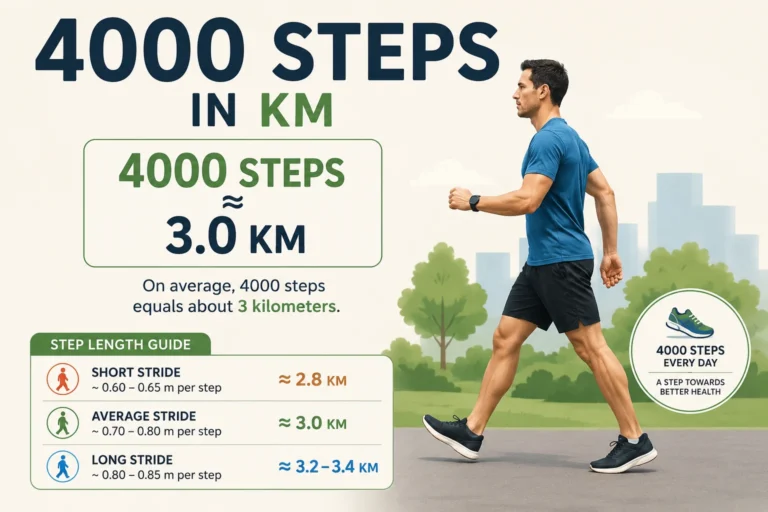
Many people tracking their fitness goals often wonder how far their daily steps actually translate into real-world distance. If you are asking about 4000 steps in km, the average distance is usually between 2.8 and 3.2 kilometers, depending on stride length, walking speed, height, and gender.
4000 steps in km Walking has become one of the simplest and most accessible ways to improve physical health, mental wellbeing, and daily activity levels. Whether someone uses a smartwatch, fitness tracker, or phone app, step counts provide an easy way to monitor movement throughout the day.
This guide explains how far 4000 steps is in KM, how step conversion works, calories burned, walking time estimates, and whether 4000 steps per day is considered healthy.
How Far Is 4000 Steps in KM?
Average Distance Conversion
For most adults,4000 steps in km steps equal approximately:
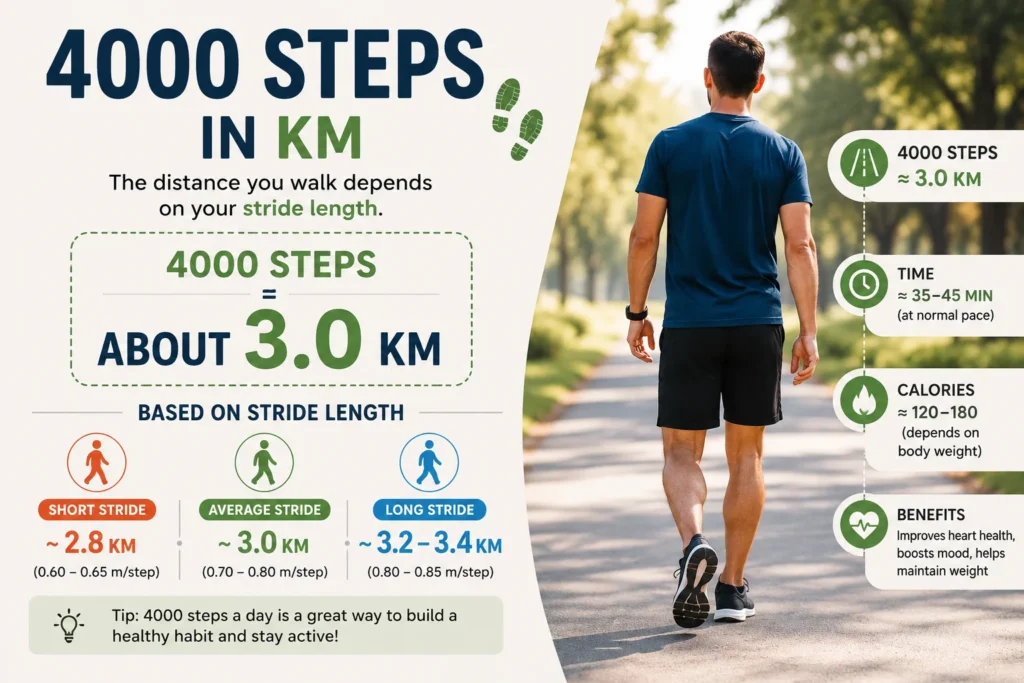
4000 steps≈2.8–3.2 km
The exact distance depends mainly on stride length. A person with longer legs typically covers more ground per step compared with someone shorter.
On average:
- Women often average about 0.67 to 0.73 meters per step
- Men often average about 0.75 to 0.80 meters per step
Because of these natural differences, two people walking the same number of steps may travel slightly different distances.
Simple Formula for Step Conversion
A basic way to estimate distance is:
Distance=Steps×Stride Length
If an average stride length is about 0.75 meters:
4000×0.75=3000 meters=3 km
This estimate works well for casual walking and general fitness tracking.
What Affects the Distance of 4000 Steps?
Height and Stride Length
Height is one of the biggest factors affecting step distance. Taller individuals usually take longer strides, meaning they travel farther with fewer steps.
For example, someone with a shorter stride may only cover 2.7 kilometers in 4000 steps, while a taller walker could exceed 3.3 kilometers.
Fitness trackers often allow users to customize stride length settings for more accurate calculations.
Walking Speed and Terrain
Walking speed also influences stride length. Faster walking generally increases the distance covered per step because strides naturally become longer.
Terrain matters too. Walking uphill, on sand, or through crowded areas often shortens step length and reduces overall distance traveled.
This explains why treadmill step counts and outdoor walking distances sometimes vary slightly.
How Long Does It Take to Walk 4000 Steps?
Average Walking Time
Most people can complete 4000 steps in:
- 30 to 45 minutes at a moderate pace
- Around 25 minutes during brisk walking
- Longer if walking casually or stopping frequently
The pace depends on age, fitness level, and walking environment.
A relaxed evening walk around the neighborhood may take closer to 45 minutes, while a brisk morning fitness walk could be significantly faster.
Walking Pace Comparison
| Walking Speed | Estimated Time for 4000 Steps |
|---|---|
| Slow pace | 45–50 minutes |
| Moderate pace | 35–40 minutes |
| Brisk pace | 25–30 minutes |
This makes 4000 steps in km realistic and manageable daily movement goal for many people.
Calories Burned Walking 4000 Steps
Estimated Calorie Burn
The number of calories burned during 4000 steps depends on body weight, pace, metabolism, and walking intensity.
On average, most adults burn:
- Approximately 120 to 220 calories
- More during brisk or uphill walking
- Less during slow-paced movement
Heavier individuals generally burn more calories because the body requires more energy for movement.
Factors That Influence Calorie Burn
Several factors can increase calorie expenditure during walking:
- Faster walking speed
- Incline or hill walking
- Carrying weight
- Longer stride movement
- Higher body weight
Fitness watches and apps use formulas based on these variables, although estimates may not always be perfectly accurate.
Is 4000 Steps a Day Healthy?
Better Than a Sedentary Lifestyle
While many people focus on the popular 10,000-step goal, research increasingly suggests that even moderate daily movement provides meaningful health benefits.
Walking 4000 steps in km daily is generally healthier than remaining sedentary for most of the day. Regular walking may support:
- Improved cardiovascular health
- Better circulation
- Stress reduction
- Increased mobility
- Higher daily calorie expenditure
For beginners or older adults, 4000 steps can be an excellent starting point.
Building Sustainable Habits
One reason walking goals work well is because they are realistic and sustainable for many lifestyles.
Someone working at a desk all day may find 4000 steps easier to maintain consistently than very high fitness targets. Over time, daily movement habits often increase naturally as endurance improves.
Consistency matters more than perfection when building long-term healthy routines.
Ways to Reach 4000 Steps Easily
Simple Daily Habits
Many people reach 4000 steps in km without formal workouts simply by becoming more active during normal routines.
Helpful strategies include:
- Taking short walking breaks during work
- Walking after meals
- Using stairs instead of elevators
- Parking farther away
- Walking while talking on the phone
Small movement choices throughout the day can add up surprisingly quickly.
Indoor vs Outdoor Walking
Outdoor walking often feels more enjoyable because scenery and fresh air help reduce boredom.
However, indoor walking can still be effective, especially during bad weather or busy schedules. Treadmills, walking pads, shopping malls, and indoor tracks all help people stay active consistently.
The most effective walking routine is usually the one someone can maintain regularly.
4000 Steps Compared With Other Step Goals
How It Compares to 10,000 Steps
The 10,000-step goal became popular through marketing campaigns decades ago, but health experts now recognize that benefits occur at many activity levels.
Here is a general comparison:
| Steps | Approximate Distance |
|---|---|
| 2000 steps | 1.4–1.6 km |
| 4000 steps | 2.8–3.2 km |
| 6000 steps | 4.2–4.8 km |
| 10,000 steps | 7–8 km |
Even moderate increases in activity can positively affect overall health.
Realistic Fitness Expectations
Not everyone has the same schedule, mobility, or physical ability. For some individuals, 4000 steps in km daily steps may represent significant progress.
Walking goals should match personal health needs, lifestyle, and fitness levels rather than social media trends or unrealistic expectations.
Building a sustainable habit is often more beneficial than chasing extremely high targets inconsistently.
Mental Health Benefits of Walking
Stress Reduction and Mood Improvement
4000 steps in km Walking is not only beneficial for physical fitness but also supports mental wellbeing.
Research consistently links regular walking with improved mood, lower stress levels, and better emotional balance. Gentle movement can help clear the mind and reduce feelings of mental fatigue.
Outdoor walking in green spaces may offer additional psychological benefits through exposure to nature and sunlight.
A Simple Form of Daily Self-Care
One reason walking remains so popular is its accessibility. It requires no expensive equipment, gym membership, or advanced training.
For many people, a daily walk becomes a peaceful routine that supports both mental clarity and physical activity at the same time.
Even 4000 steps in km can create a meaningful sense of accomplishment and movement during busy days.
Frequently Asked Questions
Q: How many kilometers are 4000 steps?
A: For most adults,4000 steps in km equal approximately 2.8 to 3.2 kilometers, depending on stride length and walking style.
Q: How long does it take to walk 4000 steps?
A: Walking 4000 steps usually takes between 30 and 45 minutes, depending on walking speed and terrain.
Q: Is 4000 steps per day enough?
A: Yes. While higher activity levels may provide additional benefits, 4000 daily steps are generally healthier than a sedentary lifestyle and can support basic fitness and wellbeing.
Q: How many calories does 4000 steps burn?
A: Most people burn around 120 to 220 calories during 4000 steps, depending on body weight, pace, and walking intensity.
Q: Can 4000 steps help with weight management?
A: Walking 4000 steps in km daily may contribute to weight management when combined with balanced nutrition and consistent physical activity habits.
Conclusion
Understanding 4000 steps in km helps make fitness tracking more practical and meaningful. For most people, 4000 steps translate to roughly 3 kilometers of walking, although stride length and walking pace can slightly change the final distance.
More importantly,4000 steps in km daily walking offers benefits that go beyond numbers. Regular movement supports heart health, mobility, mental wellbeing, and healthier daily habits without requiring intense workouts or complicated routines.