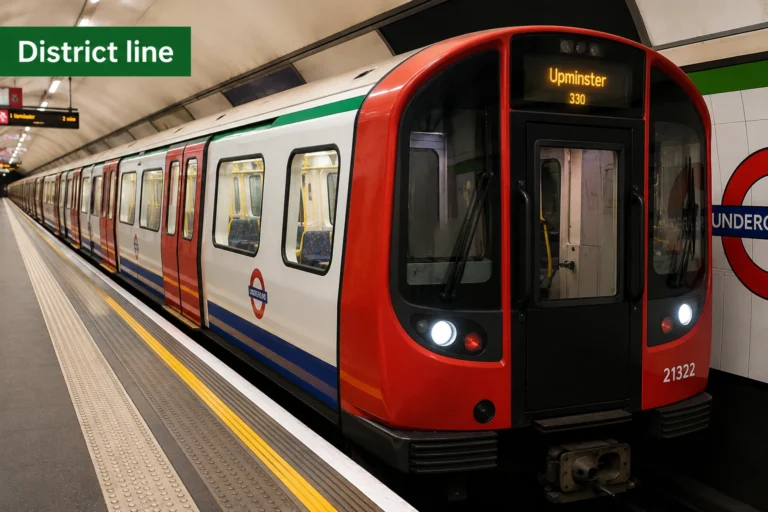
The District Line is one of the most historic and heavily used routes on the London Underground. Identified by its distinctive green color on the Tube map, the line stretches across London from Upminster in the east to branches serving Richmond, Ealing Broadway, Wimbledon, and Edgware Road in the west. With 60 stations across approximately 64 kilometers (40 miles), it serves more stations than any other Underground line.
Originally opened in 1868, the District Line helped shape London’s modern transport network and played a major role in the city’s expansion. Today, it remains essential for commuters, tourists, and residents, connecting business districts, cultural landmarks, residential neighborhoods, and major transport hubs.
Whether you’re planning a visit to London or simply interested in railway history, the District Line offers a fascinating blend of Victorian engineering, modern transportation technology, and everyday practicality.
What Is the District Line?
The District Line is a sub-surface railway within the London Underground network. Unlike deep-level Tube lines, many sections operate in shallow tunnels or above ground, allowing for larger trains and more spacious passenger accommodation.
The line serves a wide variety of destinations across Greater London and acts as one of the primary east-west transport corridors. Its extensive network makes it especially valuable for passengers traveling between suburban areas and central London.
Today, the District Line is considered the busiest of London’s sub-surface Underground lines and remains a crucial part of the city’s transportation infrastructure.
History of the District Line
The Origins of the Metropolitan District Railway
The story of the District Line began in the mid-nineteenth century when London faced severe transportation challenges due to rapid population growth.
In 1864, the Metropolitan District Railway was established to help create an underground rail network linking major railway stations throughout central London. The first section officially opened on December 24, 1868, making it one of the world’s oldest underground railways.
At the time, trains were powered by steam locomotives, which created significant challenges in enclosed underground environments.
Expansion Across the Capital
Following its successful launch, the railway expanded steadily.
New sections connected important areas including Richmond, Ealing, Fulham, Hounslow, Whitechapel, and eventually Upminster. These extensions helped transform suburban development by making it easier for people to live farther from central London while maintaining convenient access to work and services.
By the end of the nineteenth century, the District Railway had become one of London’s most important transport providers.
Electrification and Modernization
A major milestone occurred when the line was electrified in 1905.
Electric trains replaced steam-powered services, dramatically improving passenger comfort, reliability, and operational efficiency. Electrification also eliminated many of the smoke and ventilation issues associated with steam locomotives.
This modernization laid the groundwork for the modern District Line that millions of passengers use today.
District Line Route and Branches
Eastern Section
The eastern terminus of the line is Upminster, located in East London.
Key stations along the eastern route include:
- Upminster Bridge
- Hornchurch
- Elm Park
- Dagenham East
- Barking
- East Ham
- West Ham
These stations provide important commuter connections into central London and surrounding areas.
Central London Corridor
As the line enters central London, it serves several of the capital’s most important stations.
Major central stops include:
- Tower Hill
- Monument
- Blackfriars
- Victoria
- Westminster
- South Kensington
These stations provide convenient access to London’s financial district, government institutions, museums, shopping destinations, and tourist attractions.
Western Branches
One of the District Line’s most distinctive features is its multiple western branches.
From Earl’s Court, services split toward:
- Wimbledon
- Richmond
- Ealing Broadway
- Edgware Road
- Kensington (Olympia, limited service)
This branching structure allows the line to serve a remarkably diverse range of destinations across West and Southwest London.
Major Stations on the District Line
Westminster Station
Westminster Station is one of the most popular stops on the line.
Located near some of Britain’s most iconic landmarks, it provides easy access to:
- Big Ben
- Palace of Westminster
- Westminster Abbey
This station is frequently used by tourists exploring central London.
Victoria Station
Victoria serves as one of London’s busiest transport interchanges.
Passengers can connect to national rail services, buses, coaches, and other Underground lines. The station’s strategic location makes it a critical transportation hub for both local and long-distance travel.
South Kensington Station
South Kensington is the gateway to London’s famous museum district.
Nearby attractions include:
- Natural History Museum
- Science Museum
- Victoria and Albert Museum
Millions of visitors use this station annually to access these world-renowned institutions.
District Line Trains and Technology
S7 Stock Trains
The District Line currently operates modern S7 Stock trains.
These trains offer numerous improvements over previous generations, including:
- Air conditioning
- Walk-through carriages
- Digital information displays
- Improved accessibility
- Enhanced passenger comfort
The introduction of S7 Stock significantly modernized the passenger experience.
Signaling Systems
Transport for London has invested heavily in advanced signaling technology to improve line performance.
Modern systems help increase train frequency, improve reliability, and reduce congestion on one of London’s busiest Underground routes.
Accessibility Improvements
Many stations on the District Line have received accessibility upgrades.
These improvements include better signage, step-free access at selected stations, and enhanced facilities designed to support passengers with mobility needs.
Unique Facts About the District Line
The Most Stations on the Underground
The District Line serves 60 stations, more than any other London Underground line.
Its extensive coverage contributes significantly to its popularity among both commuters and visitors.
River Thames Crossings
The District Line is unique because it crosses the River Thames via bridges rather than tunnels on some sections.
The Richmond and Wimbledon branches both feature above-ground river crossings, making the line unusual within the Underground network.
One of the Oldest Underground Railways
Opening in 1868, the District Line is among the oldest underground railway systems ever built.
Its history spans more than 150 years of transportation innovation.
Tourist Attractions Along the District Line
Kew Gardens
Visitors traveling to Royal Botanic Gardens, Kew can use Kew Gardens station.
The site is famous for its botanical collections, historic glasshouses, and UNESCO World Heritage status.
Wimbledon
Sports fans can access the world-famous All England Lawn Tennis and Croquet Club via the Wimbledon branch.
The venue hosts the prestigious Wimbledon Championships each year.
Tower of London
Passengers can reach the historic Tower of London using nearby Tower Hill station.
This iconic fortress remains one of London’s most visited attractions.
District Line Services and Frequency
The line operates frequent services throughout the day.
Recent schedules typically provide multiple trains per hour on each branch, with especially frequent service through the central section between Earl’s Court and Tower Hill. During peak periods, trains may arrive every few minutes.
This high frequency helps accommodate the line’s substantial passenger demand.
Frequently Asked Questions
Q: What color is the District Line?
A: The District Line is shown in green on the London Underground map.
Q: How many stations does the District Line have?
A: The line serves 60 stations, the highest number on any London Underground route.
Q: When did the District Line open?
A: The first section opened on December 24, 1868.
Q: Is the District Line underground the entire way?
A: No. It is a sub-surface railway, meaning significant portions run above ground or in shallow tunnels.
Q: What trains operate on the District Line?
A: The line currently uses modern S7 Stock trains equipped with air conditioning and walk-through carriages.
Conclusion
The District Line is far more than just another London Underground route. As one of the oldest underground railways in the world, it has played a central role in shaping London’s growth and transportation network. With its 60 stations, extensive east-west coverage, multiple branches, historic significance, and access to some of the city’s most famous attractions, the District Line remains one of the most important and fascinating parts of the London Underground system. Whether you’re commuting across the capital or exploring London as a visitor, the District Line continues to provide a reliable and historic journey through one of the world’s greatest cities.